...

Is working out in the heat really dangerous?

Can heat actually be harmful?

In short, yes! Heat can be harmful and even be deadly if you do not take the necessary precautions.

What happens when you exercise?

The temperature of our deeper tissue is in a dynamic balance between heat loss / gain. If because of exercise or external influences this equilibrium is interrupted the core temperature rises. In elite athlete the temperature can raise by 1.8° F / 5-7 min if exercising at intense aerobic levels.
Your body cannot let this go on indefinitely without taking damage therefore regulatory processes take place.

Ways of transferring heat away from the body

  1. Radiation (we radiate electromagnetic heat waves through the air to solid cooler objects in our environment)
  2. Conduction (is the heat transfer directly from one molecule to another, hand to air, or hand to water for example)
  3. Convection is dependent on the air or fluid exchange surrounding our body. If the air does not move, it functions as insulation after heating up to body temperature. This is the reason why a fan works so well :-).
  4. Evaporation is the major player in the fight against overheating. Water vaporizes from the respiratory passages and skin surfaces which continually transfers heat to the environment.

How does your body activate its cooling mechanisms?

We have an increased circulation to our face and skin in general. in extreme heat 15-25% of our cardiac output goes to the skin. This increased blood flow improves our ability to give heat off to air molecules.

Sweating starts within a couple of seconds of intense exercise. It takes about 30 min before it reaches an equilibrium  with the exercise load. The increased circulation combined with the effects of conduction and evaporation lead to cooled blood flowing back to the core and taking on more heat to transport off. Additionally hormonal changes regulate down the salt content in sweat which prevents early onset of cramping.

What happens when it is hot and humid outside?

In high temperatures radiation (emitting heat waves) , conduction (molecule to molecule) and convection (air heating and it’s replacement) won’t work anymore. If the outside temperature is higher than the core temperature you might actually gain heat from those three.

Now if humidity comes out to play it gets even worse. Now we have another problem. Humidity will take out our major player, Evaporation.  The air around us is more saturated with water and our sweat will no longer evaporate. Instead it will run down without having a cooling effect and we run into the danger of overheating and dehydration. Individuals are actually capable of resisting relatively high temperatures as long as the relative humidity is low.

What effect does your clothing have?

Changing from wet to dry clothing actually does not help. dry clothing usually slows down heat exchange. Moisture wicking clothing can help to optimize heat transfer especially in intense exercise during hot weather.

If you ignore the heat

Bad things will happen if you ignore the heat. Your performance drops because huge amounts of blood are diverted to cool you off. Renal and liver complications are common during exertional heat stress. The core temperature raises to dangerous levels which reduces the drive to exercise leads to fatigue in order protect your body from damage.

How does it show?

Heat cramps, heat exhaustion (weak, rapid pulse, headache, dizziness, general weakness) and heat stroke (failure of heat-regulating mechanisms) are a clear sign of overheating In case of a heat stroke the circulatory system collapses (absence of sweating, altered mental status) and a person can die. Medical intervention is crucial. The person should replace fluids, be cooled down by ice packs to the neck area.

I know the summer is almost over but we are still having hot days
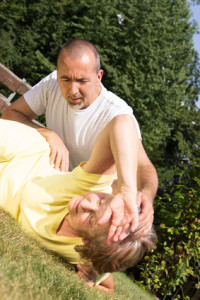
Woman is receiving help after having a heatstroke
You don’t want to be caught unaware by the heat

. So please pay attention. No training session is worth risking your health or life. Cut the training short, choose to change the location or ease off.

Have an awesome day,

Michael

References:
McArdle et al. (2007). Exercise Physiology – Energy, Nutrition & Human Performance. 6th Ed. Lippincott Williams & Wilkins.

Lifting Weights And Wondering Why You Are Still Looking The Same?

7 Common Mistakes When Picking Up Weight Training.

  1. You don’t have a clear goal: No matter what you want to accomplish you have to have a clear goal. You might want to lose body fat, gain lean muscle mass, or improve strength & power. You have to decide on what you want to accomplish. Not all goals are mutually exclusive but they also may not be optimal together. Your training needs to be clearly structured based on your goals!

    Middle aged woman squatting with kettlebell
    Strain without Gain?
  2. You have Workout ADHD. You are changing everything every time, you see a new exercise you will incorporate it, you do 60 push ups and then decide to train power the next day. You change everything, every time. You don’t give your body enough time to improve at something. Stick with a program for 6-8 weeks before you change it and you will be surprised by the results.
  3. You are TOO resistant to change. You are the person who lifts the same weight, uses the same machine, the same routine, the same reps for months, years and decades. This person has the opposite problem of  #2. Your body has gotten so used to the training, it does not provide a stimulus for change anymore.
  4. You think Progressive Overload has to do with a truck weigh in. In all seriousness, you need to actually try to lift more weight every time you train. It does not mean you will succeed, but at least try. If you are within 90% of your capacity you will still see improvements for a while but you need to try to push the limits up. I might just go up by 1-2 lbs. If I did that every week I would increase my weight pushed or pulled by 50-100 lbs a year. Obviously it is not possible every week, but the emphasis is on try!
  5. You think FORM only applies to dancers. If someone watches you lift it should look like they could put it into a book or make an educational video of it (and not as a bad example). If you get hurt during lifting, you will have to take a break, unless you want to break. That break then will negate all the hard work you have done prior to your injury.
  6. You think Nutrition is for Meatheads and Alternative Rabbit Food Eaters: Well, since you are literally what you eat, food matters. You don’t have to become a food nazi but having high quality foods provides you with the protein, carbs, fats and micronutrients you need in order to build quality muscle tissue, repair cell damage done during your training and let’s you progress. Get back to cooking your food yourself, by veggies, high quality meats, poultry, fish, fruits, etc and see the difference it can make. (You have to eat it too, don’t just buy it)
  7. You think sleep and rest is for the weak. You have bought into the belief that it is almost womanly or manly if you sleep little, work a lot and pretend like it does not affect you. Rest and sleep let’s you get stronger after your hard workouts. It allows cell repair, hormones to reset, and your body to find a balance between anabolic and catabolic processes.

If you are struggling, or standing still in your training then look at those 7 factors above, and be honest about it. How much of it are you applying to yourself. Just one of those factors not lined up may hinder you from getting your new PR or inhibit your progress.

If you have any questions about your training, feel free to get in touch with me or one of my trainers, or leave a comment.

Have an inspiring day!

Michael


Fat Blaster TV Workout

Football, or our favorite shows are upon us again. The kids are going back to school and the busy and hectic lifestyles resume. But sitting and watching our favorite shows or

Woman doing a fitness workout in front of the TV
You can use commercials as workout breaks
Young woman exercising at home doing side planks
you will be even more happy for the commercial to be over

entertainment does not have to mean not working out. 13-16 min of an hour of TV is usually advertisement. It is evenly spaced out and provides an excellent opportunity to get a workout in.

The Warm Up 

  • 25x Sit down and stand up of the couch without using your arms
  • 25x Jumping Jacks

The Workout 

  • 10x Dips using chair or coffee table
  • 15x Squats with pulse on the bottom of the movement
  • 45s Plank
  • 60 Mountain Climbers
  • 15 Bridges (single leg or two legged)
  • 30 Fast Jumping Jacks
  • 15 One arm band rows or TRX rows
  • 20 Reverse lunges

You can repeat this workout 3-4 times depending on how much time you have. You definitely get something done and won’t feel like a couch potato.

Enjoy your favorite shows!

Have a great week,

Michael


How Low Can You Go – Or What Is A Good Squat Range?

In one of my recent Facebook and Google+ posts I talked about the importance of maintaining spinal integrity during a squat. A lot personal training clients come to us had back, knee or hip injuries before.

For a long time there was the believe that you should not squat below a 90° angle in the knee. This has changed in the past couple of years and the fitness industry has encouraged people to squat lower.

There have been terrible consequences. Without really knowing how to perform a squat safely, or knowing if they have the physical capabilities people have driven their butt to the floor and are getting injured. I will give you an example from Youtube. The stuff people put there is fantastic learning material on how not to do it!

Start watching at 35s. You only need to watch the first squat. It is bad enough.

Now, despite the fact that there is about everything wrong with this squat, he goes into hyperlordosis, and proceeds to have a terrible butt wink, and then comes up with terrible form, we focus on the hip tucking under!

Todays blog is only about the butt wink!

So what in the world is that. The butt wink is the part when your hip tucks under and you start rounding your back. If you look at the two photos below you will see the difference between a proper bodyweight squat and one where I am going too low.

If done correctly the back should maintain it’s natural S-curve.

bodyweight squat with S-Curve maintained

The red line I used, helps to clarify how spinal integrity is maintained. If you are looking now at the second picture you will see that I am going lower, since we all know, lower is better! Well, maybe not:

Bodyweight squat without spinal integrity

My butt is tucking under. For several reasons I am physically not capable of going that low without compromising my back. Those reasons can be tight muscles, structural hip problems, pain, you name it. The pressure on those lumbar discs is exponentially higher in the lower picture. I might not get hurt doing it once or twice or twenty times but with more load or repetition I could get severely injured and risk a permanent impairment. If you want to squat better reduce the range of motion. Don’t get me wrong, I am all for a full range squat, if you can perform it safely without getting injured.

Here is how a squat, in this case a front squat should look like. Don’t get me wrong. This is not perfect. For one I am not happy with my head positioning, but that is a topic for another time. The lumbar spines integrity is maintained. I am minimizing shearing forces on the disc.

I hope this has been helpful to you. Happy squatting!

Your comments and questions are always welcome.

Have a wonderful day,

Michael

What to do when you sprain your ankle?

Ankle sprains are pretty common. Many of us have had one and if you had one, there is a good chance you will have or had a second one. You step off the curb, step wrong just for one second, and bang, your ankle goes out of under you.

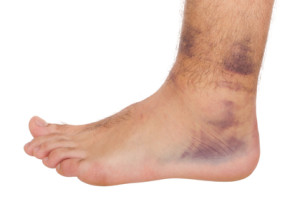
Inversion ankle sprain with strong hematoma
Not a pretty sight!

What is an ankle sprain?

The most common ankle sprain is the inversion ankle sprain. The sprain is graded into 3 different categories.

  • Category one leads to some stretching or minor tearing of the ligamentous fibers. The joint stability is usually not compromised. You might feel the joint to be a little bit more stiff, but usually there is not a lot of swelling, and only mild pain.
  • The second degree sprain is a different matter. The joint is definitely more unstable, there is more tearing and separation of ligamentous fibers.
  • The third grade involves a total rupture of the ligament and severe instability of the joint, profuse swelling and severe pain. A third degree sprain can be accompanied by other ligament or structural injuries  in the joint. and surgery might be necessary.

What to do at first?

RICE – rest it, ice it, compress it and elevate it is probably the most important thing to do in an ankle injury initially. Depending on the severity of the sprain you might have to have the ankle immobilized for a couple of weeks, or even have surgery (usually 3rd degree sprain).

What to do later?

Here comes my disclaimer, I am not a physician and don’t try to be one. This advice is not for you to treat yourself but be a little bit better informed. It certainly does not replace your healthcare professional.

In the beginning you will have to scale back on vigorous training (that is at least what the textbook says). Well, you have other body parts you can work out vigorously without compromising joint integrity. You will have to lay off of running, jumping or some leg exercises but don’t think you can get out of working out once you are past the first 3-5 days. Once you are allowed to be weight bearing again you can even try some aquatic exercises which allow you to be partially weight bearing, and you have some compression from the water on the joint. Neat trick!

Now if you only have a minor ankle sprain you don’t have to go into the pool to exercise. You will want to stay initially with bilateral movements that minimize eversion or inversion of the foot. Avoid forcing range of motion. Stability seems to be the key. Pain should be the guidance and you want to progress to range of motion exercises as quickly as possible. Later on it is important to maintain the appropriate range of motion via mobility work.

Training balance as soon as it is painfree can help stabilize the joint against future injuries. Some people question the use of balance boards, bosu balls, etc. with the argument that they defy the argument of specificity. The next step would be the transition from walking to running, lateral movements with stabilization and finally cutting and sport specific exercises. Strength training should be functional and look at the whole body not just the ankle joint. Gait analysis and corrections should be made and progressions should be dependent on owning the movement. Pain should be seen as an indicator to back off.

Take Away

Stage 1

  1. RICE (rest, ice, compression, elevation)
  2. Exercises stressing plantar and dorsiflexion (pointing your foot and pulling the foot back)
  3. Cycling and hand ergometer

Stage 2

  1. Range of motion in all planes
  2. reduce swelling and pain
  3. Balance exercises

Stage 3

  1. Full strength
  2. Full range of motion
  3. Restoration of proprioception
  4. Reintegration into sports

Rehab nowadays does not reduce you to one join anymore, at least it should not. Your training should still be challenging but take into account that your ankle is a problem. Pain is always the guidance. Pain changes movements and innervation patterns. Just because you are able to still do the movement clean with pain, does not mean that the muscle that the integrity of the kinetic chain is still given. Unilateral strength exercises are functional and add stability to your strength training but initially after returning to your strength training you might have to regress back to bilateral work in order to really focus on strength. If you look at the make up of a training session it would look something like this:

  1. Foam Rolling
  2. Mobility work as allowed
  3. Ankle stability training
  4. Strength training
  5. Conditioning

I hope this has been helpful,

Have a great start into the weekend,

Michael


References:
Cressey, Eric (6/23/2014 online) http://www.t-nation.com/training/bosu-ball-the-good-bad-and-ugly/print
Prentice, William E. (2004).  Rehabilitation Techniques for Sports Medicine and Athletic Training
Peterson & Rendström (2001). Verletzungen im Sport. Prävention und Behandlung. 3. Auflage. Deutscher Ärzte-Verlag.

What to do when your knee hurts!

A lot of my personal training clients, myself included have had knee pain at some point and time in their life.

You might remember this nagging pain under the knee cap, maybe off to the side. Some feel it just below the knee or they have problems straightening their leg because the knee feels tight.

The knee is one of the most complex joints in the body. It has many surfaces that glide over each other. It is being held in place by strong ligaments and is stabilized and moved by the muscles of your whole leg. Yep, the whole leg. You might wonder now what youknee_arthroplasty_anatomy01r butt or your calf has to do with the knee but we will get to that in a little bit.
First I need to tell you what this article is NOT, it is not a guide how to treat acute or chronic injuries yourself. First of all, I am not a medical professional, second of all, it would go beyond the scope of this blog. What the blog will do though, is get you a little bit better at understanding your body in order to help you discuss your issue with your fitness or health care professional and understand how your training impacts your knee.

The causes for knee injuries differ widely. Some are caused by an acute injury, like you tripping, someone sliding into you during sports, etc. Others come on chronically due to biomechanical factors which could be habitual, genetic, etc. and some are a combination of the above.
Your training might be able to train up your legs, make them stronger and more injury resistant to acute injuries (see above). Now when it comes to biomechanical problems it gets a little bit more complicated. Here the goal is to correct an underlying issue. Depending on its nature that might not be possible. You might have been born with a severe leg length difference, scoliosis, etc. Factors that we as trainers or health care professional might not be able to correct at all or only minimally.

So what can training do for you?

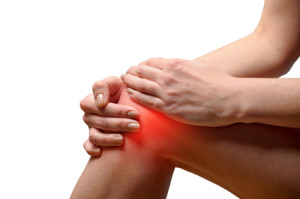
Young woman having knee pain
Is your knee hurting as well?

A lot of chronic knee issues come from the joint above or below the actual knee. I always tell my clients the following analogy: “If one of two workers goes on vacation, which one is the most likely to complain about it?” The answer is obvious, the one doing all the work. Especially with chronic knee pain we often see that the hip muscles are not able to do their job for various reasons. The hip joint is not properly stabilized or mobile enough which in turn can lead to problems in knees or back.

Bad Movement – No Pain

When a personal training client comes to us, we perform a comprehensive initial consultation to check out their movement patterns, see if pain exists, etc. Occasionally we find dysfunctional movements that do not cause pain. Oftentimes using proper lateralization/regression exercises, we are capable of activating and correcting those movement patterns and prevent an injury from happening.

Pain with Movement

In case we already have an existing pain pattern, we refer the client out to a health care professional we trust, in order to work in tandem on the problem. Together we create a cohesive team dedicated to our client’s well being.

For a long time therapists were focused solely on the muscles surrounding the affected joint. In case of the knee they would work the quads and hamstrings. One of the favorite machines back in the day was the knee extension. Extensive research and a lot of ruined post-patellar cartilage later this machine finds less and less use.

Since then, things have come a long way. Good physical therapists during the rehab phase, and personal trainers and coaches during the reintegration phase, have started to look at the whole kinetic chain. We have realized that we cannot just look at the muscles surrounding an affected joint. Don’t get me wrong those have to be addressed appropriately, but we have to look at what is happening above and below. good hip stabilization, ankle stabilization and movement patterns very much influence the knees.

What does that mean in regards to your training?

Single leg deadlifts, deadlifts, bridges, chop patterns half kneeling or tall kneeling and so many more exercises can be  great tools in your tool box. We have found that when you train a client who has knee pain and stay away from pain causing movements and focus on hip exercises, we often see improvements in their pain and movement patterns, and pain free range of motion.

Despite us not doing any treatment at the hurting location and instead addressing the muscles that were not working properly prior to the injury we were able to help some clients minimize their pain, or eliminate it completely.

So, just because your knee hurts does not mean you cannot train legs. You have to train smarter!

Have an awesome day,

Michael


Seraphinite AcceleratorOptimized by Seraphinite Accelerator
Turns on site high speed to be attractive for people and search engines.