Todays blog is provided by Troy Groce. He is one of my personal trainers and specializes in a corrective approach to training. He is sharing some thoughts on rushing towards braces whenever something seems to be uncomfortable:
A brace is not always the right way to go
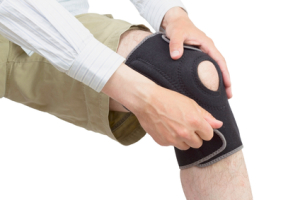
Our society has become brace happy. At the first sign of discomfort people brace joints more often than they should. Bracing may provide temporary relief, but it can pose more extensive long term problems. However, bracing is appropriate when a joint is significantly injured or unstable and/or when any excessive additional movement can cause further injury. Knowing the difference between discomfort and acute pain is essential. Significant acute pain should be diagnosed by a medical practitioner.
Bracing at the first sign of discomfort and restricting movement can actually slow down the healing process. Movement at a joint when it’s mildly injured brings blood flow to help in the recovery process. Bracing weakens the stabilizing muscles and connective tissue around the joint. Wearing a brace too long causes the joint to grow weaker, possibly resulting in a more significant injury to the specific joint or dysfunction in other related joints. The root issue of most non-traumatic joint pain is usually associated with improper movement patterns that can be simply addressed with a proper corrective exercise program.
I am looking forward to helping you with your goals,
The diagonal lift on a cable machine is a great tool to work shoulders and core stability.
What does the lift do?
Time to stop doing this and start working smarter
This exercise falls into a similar category as the “isometric pallof press” in that it works the core isometrically, forcing you to resist rotational forces. In addition though, it trains your anterior and medial delts for a nice set of shoulders!
How to do it!
We usually start our personal training clients in a tall kneeling position in order to minimize initial instability. The task is to keep the core stable while lifting the rope diagonally past the opposing shoulder, away from the cable. It is crucial to maintain hip stability at all times.
Progressions would be:
Half kneeling
Standing
Altering movement speed
The true test will be performing this exercise fast and maintaining form at all times.
What do I need to pay attention to?
You can squeeze a pad or foam roller with your knees in order to help with stability
Keeping the hips and torso from rotating.
Keep the shoulders packed
Vary the speed of the exercise and the load
I would love to help you with your core or sports performance training. Let me know if my team of personal trainers and coaches and I can help you.
The two most common goals people have when coming to a personal trainer are weight loss (fat loss) and weight gain (muscle mass). This blog is about the differences in training and nutrition.
Do you feel like our friend here sometimes?
What they all have in common!
Both goals are highly dependent on your nutrition, a well setup training plan and extracurricular activities. Equally important for the success of your program are sleep and active rest. What does active resting mean? It means that you are not sitting at home on a couch, but pursuing an active lifestyle. A moving body is better circulated, reduces the insulin resistance of muscle cells, and improves recovery by nutrients reaching the cells faster, leaving you ready to go again!
Weight Loss (Fat Loss) as a goal
If you are trying to seriously lose weight and body fat, then you are faced with a myriad of tasks that can be quite overwhelming. The first and foremost goal that I have is really getting the person to move again. Obese people sit about 2.5 hours more per day (Levine 2014) than none-obese people. Time to get off your butt! I know you work a lot of hours, but get a standing desk, walk during phone meetings, take the stairs up and down, do anything but sit.
According to juststand.org a 170 lb person sitting at work burns about 1000 kcal total over the course of 8 work-hours, whereas the same person burns 1360 kcal when standing – that is an extra 360kcal per day! Compare this to an average 30 minute workout session that burns 200-300kcal. Over a one week period that extra calorie burn translates to real weight loss. What would happen if you start moving more the rest of the day as well?
Now we start adding exercise into the mix. You lift weights 2-3 days a week for 30 min, and boom, you preserve your muscle mass while losing body fat. Let’s say you are super motivated and do 2-3 days a week of some high intensity interval training and really rev up that metabolism. You are pretty golden at this point. Total amount of exercise per week: 1:30 hours – 3 hours.
You know that nutrition is important. You have heard multiple times that you are what you eat, and decide to make small changes every week or two. You add some fish oil because you heard it is important (Berardi 2013), next you start eating more veggies, cut back on the softdrinks, etc and start eating primarily unprocessed food. At this point those pounds are probably tumbling down like crazy. People at work won’t recognize you.
Weight Gain (Muscle Mass) as a goal
We have a couple of clients who want to gain weight. I know a lot of our weight loss clients are envious, don’t be! It can be just as challenging for someone to put on muscle mass as it is for some to lose body fat. My own body type is inherently ectomorph and I enjoy running. I know your pain.
Do you feel like our friend here sometimes?
Here is what you need to do to kill your goal. You need to pick up weights, and you need to go heavy, too. Don’t just pick up light weights, you need to work hard at 8-12 repetitions, sometimes dip into lower reps into the strength area to stimulate the muscles differently.
Here is the kick: even though you might not want to lose body fat, you should still get off your butt at work if you can. Why? Pretty simple. Out of our experience people who sit a long time will struggle with exercises that work on the hip; like squats and deadlifts, etc. That directly impacts your training efficiency. Despite the fact that being active helps you recover faster.
If someone is seriously interested in picking up muscle mass we usually recommend 3-5 days a week of strength training for 45-60 min. This does not have to be with a personal trainer. The body needs a good training stimulus during the week to be encouraged to change. Depending on the medical needs, body type, etc we might not recommend cardiovascular training during that training phase. Total amount of training per week: 2:15-5 hours.
Now, food becomes an issue again. Just because you want to gain muscle weight, does not mean you can stuff your face however you want. The goal is to take in high quality, proteins, fats, and carbs, vitamins, minerals, etc. to optimize your training progress and minimize the fat gain. Too many people completely blow up with body fat during this phase.
A gradual change to unprocessed foods is the best approach, doing it slowly, not overwhelming someone with goals.
What is the secret?
If you are reading all of this, you might be pretty overwhelmed by now. Don’t be! I think we can all agree on the fact that we want a permanent transformation not necessarily a fast but fleeting change. Here is the secret on how to accomplish all of your goals relatively easily:
In order to accomplish your goals follow the rule of “easy changes first”. Do whatever change comes easy to you first. It might be being more active, nutrition, training, or aspects of each. It does not matter! Simply start with what is doable and implement a new change every 1-3 weeks. Eventually you will have transformed yourself and changes that seemed to be difficult at first, are all of a sudden easy.
Key points:
Standing at work can burn as much as if not more calories than working out with a trainer for 30 min 2x a week.
Move during the day
Slowly make changes to nutrition
Will see weight loss without big $ or time investment
Please let me know if we can help with your transformation,
Michael Anders
Berardi, John & Andrews, Ryan (2013). The Essentials of Sport and Exercise Nutrition. Precision Nutrition.
http://www.juststand.org/Tools/CalorieBurnCalculator/tabid/637/language/en-US/Default.aspx (2014).
Levine, James (2014). Get Up! – Why Your Chair Is Killing You And What You Can Do About It. palgrave macmillan.
We find that people are often obsessed with core exercises. I personally think they are important but for different reasons than slimming down the waistline, because that is the one thing core exercises don’t do.
Unlike our model here keep you spine aligned -)
Do Core Exercises slim the waistline?
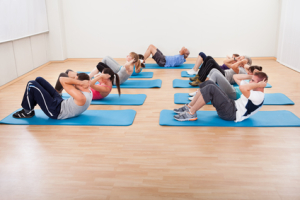
If you do a lot of crunches, rotational exercises, or the combination of these two, the last thing you will do is slimming down the waist. Besides, the fact is: there is no spot-fat-reduction possible, training abs the way mentioned above will lead to muscle hypertrophy which in result in the muscle to thicken and instead of a thinner waist, you end up with a bigger one.
Another aspect that needs to be considered is the actual functional application of what we are doing. Our core muscles usually don’t lift heavy weights (your trunk during crunches, etc.) while flexing or rotating the spine. Usually the core muscles in your back and abs work together to prevent rotational forces to turn your body, or to maintain posture in an upright position resisting a load, more so than flexing and bending. Crunches, etc can put a lot of stress on discs. If you already have issues, crunches might be the last thing you want to do.
The pallof press is a great exercise that strengthens your core. It does not only work your obliques, but a host of your hip and back muscles as well. We are teaching the pallof press in a “tall-kneeling, half-kneeling, or standing” position, with “tall-kneeling as the beginner’s stage. It is crucial that both arms stay straight, the shoulders packed and the body in alignment. We have people hold the outstretched position anywhere from 10-30s three times in a set. The key is to maintain form.
The next exercise works the anterior core (straight abdominals, transverse, but also obliques), the roll out plank on the ball. It is important to maintain a neutral spine throughout the exercise. The elbows are positioned on the ball and slowly roll forward. This movement increases the leverage and you will feel your core work more intensively right away.
For both exercises we make sure that our clients breathe throughout them consistently and deeply. We avoid shallow breathing and focus on deep diaphragmatic breathing.
We all include these exercises into our routines once a client is capable of performing them with good form.
Many personal training clients come to me and ask what the easiest way is to lose weight or body fat. Well, in theory it is easy, in practice, it turns out that is not that easy after all!
Feeling Exhausted from Sitting?
You might have read my blog post about the TV workout. Well, that is a good start but if you want to make it really happen, you should keep reading!
First we need to understand what our metabolism consists of:
Basal Metabolic Rate (BMR) – minimum energy expenditure needed to maintain vital functions (measured after a 12 hour fast in a very controlled environment)
Resting metabolic rate (RMR) -metabolic rate measured during rest (up to 10% off of BMR)
Thermic effect of feeding (TEF) – energy needed to digest food (around 10% of total daily energy need)
Exercise activity – energy burnt exercising anywhere from around 10-15% or less to well over 30% and more.
Non-exercise activity thermogenesis (NEAT) – energy used for low activity movements, walking, picking up kids, light physical labor, etc.
Have you despaired before when they told you they wanted you to take in x amount of kcal and you were asking yourself if it is all worth it? The good news is, there is something you can do about it, every day. You need to increase your NEAT.
NEAT – the magic pill to success (besides good nutrition)
Office (from easy to more work/and or expensive)
brainstorm walking or using the stairs
5-10 min exercise (squats, push ups, planks, lunges, split squats, etc) or walking break every 60-90 min
You are on a phone conference (hit the treadmill at work or pace the hallway while doing while listening in
Get a standing adjustment for your desk. Dynamic standing is better for your back,
Get an adjustable standing desk with or without a slow treadmill. Great tool and improved performance after you will get used to it. Even if you walk just at 1 mph you will still cover easily 5-8 miles depending how long you use it in a day.
Walk or ride your bicycle to work.
Don’t think without asking that your company will not support one or the other. It is well worth going to HR and see what is possible.
At Home
Cleaning, laundry, household tasks
Renovations
Going for a walks in the evening
Riding a bike
Yard work
Use cardio equipment while watching TV (cheap home versions available on Amazon), make a habit of it. No TV without movment. Does not have to be intense
I use a standing desk at work. I will admit I got away from it for a little bit, part because it is a tiny one and I have way too much junk to put on it but I am back to it. I figured out that I could ride my bike to work. I will try to do that 1-2 times a week, depending on how early and how late I will be in. Nothing is set in stone. Just get off your butt and start moving.
If you think cardio is better think again. Most people work out for 30 min twice a week (if they are part of the 15% of the population working out). On average they will probably burn around 200-300 kcal each time. That is less than 100 kcal per day.
Just standing at your desk at the office can get you considerably more. Be creative. Being on your feet is the crucial thing to do. You should take a break from walking and standing not a break from sitting.
The health benefits are overwhelming. One of my clients who for years had been complaining of back problems is “cured” just by switching over to a standing desk.
Training is a great tool. I do not think that nutrition is 80% and exercise 20% of the formula to lose weight. I think the formulas is nutrition, NEAT, and exercise are always 100%, each. None of the three does well alone but all of them do well if they come into play at the same time.
Have an awesome day,
Michael
References:
Berardi, John & Andrews, Ryan (2013). The Essentials of Sport and Exercise Nutrition. Precision Nutrition.
Levine, James (2014). Get Up! – Why Your Chair Is Killing You And What You Can Do About It. palgrave macmillan.