 Skip to content
Aging: Boost Strength & Heart Health
In my last blog article, I discussed the critical role sleep plays in performance, injury prevention, and longevity. Today, I turn our attention to the other vital pillars that support your health, mental well-being, and, most importantly, Aging: Boost Strength & Heart Health,longevity.
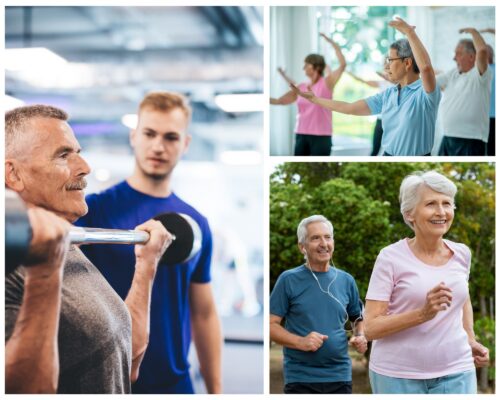
Longevity, in my perspective, doesn’t simply equate to an increased lifespan. Advancements in medicine have indeed enabled us to live longer than previous generations, but at what cost?
For me, true longevity means avoiding a future in an assisted living or nursing home; instead, I envision a vibrant, active lifestyle that includes being physically active, traveling, potentially continuing work as a trainer, and spending quality time with family and future grandchildren.
To prepare for this future, we must understand how aging affects us. Here’s some data on the topic:
Effects of Aging on You
Muscle mass diminishes by 3-5% per decade after the age of 30, a condition known as sarcopenia.
Muscle Strength
Muscle strength wanes by approximately 1.5% per year in your sixties and accelerates to about 3% annually thereafter.
What do these figures mean in practical terms? If a 30-year-old can lift 30 lbs, which suffices for stowing a carry-on in an overhead bin, this strength could diminish as follows, assuming an average annual decline of 2% starting at age 30:
- By age 40, strength might drop to about 80% of its original level, reducing the lifting capacity to approximately 24 lbs.
- By age 50, one might only retain about 64% of their original strength, equating to lifting around 19 lbs.
- At age 60, the capability might further decline to about 51%, meaning lifting only about 15 lbs.
Bear in mind, this decline isn’t strictly linear and varies significantly based on lifestyle, diet, and exercise habits, but it illustrates the general trend.
Cardiovascular Fitness
VO2 max, the maximum amount of oxygen the body can utilize during exercise, lessens by about 10% per decade after age 30. Maximal heart rate also decreases.
Many overlook cardiovascular fitness compared to strength, but I rank it just as highly. Cardiovascular capacity is partially responsible for how quickly you fatigue, whether you can dash through an airport when late, or climb stairs without getting winded.
Flexibility and Balance
With age, flexibility typically wanes, and balance deteriorates, significantly impacting the risk of falls after 70. The CDC reports that falls are the leading cause of injury-related deaths in adults over 65, with mortality rates rising with age. The one-year mortality rate after a hip fracture can soar to an astonishing 20-30%.
What Does This Mean for You?
There’s both good and bad news. While all these facets of physical fitness are trainable, and training can profoundly affect other well-being factors, like cardiovascular health and the risk of Alzheimer’s and diabetes, it also means that ignoring these aspects of well-being isn’t a viable option.
When Should I Do Something About It?
The best time was yesterday! Starting early to build a strong foundation is crucial.
Optimal Physical Activity Levels
Ideally, you should engage in 4 hours of Cardiovascular Training in Zone 2, and about 30 minutes of Zone 5 training weekly (more on this in my next article).
Strength Training should ideally encompass 4 sessions of 45-60 minutes each, including stability and balance training.
Minimum Training Requirements
While aiming for the optimal training levels is ideal, the minimum recommendation would be two Zone 2 workouts of about 45 minutes each and one Zone 5 workout of 30 minutes per week for cardiovascular health. For strength, stability, and balance, the minimum would be three 30-minute sessions weekly.
Summary
Exercise isn’t merely for vanity; it’s a cornerstone of living a high-quality life into old age. Too many people retire only to spend their days addressing health issues stemming from a sedentary lifestyle.
Regular exercise, purposefully undertaken, increases your chances of a vibrant life in your later years. Take my 80-year-old father as an example: by maintaining a rigorous routine of lifting, cardiovascular training, volleyball, and group exercises, he defies the conventions of aging.
So, what path will you choose for yourself?
Warm regards,
Your Coach,
Michael Anders
- Sarcopenia and Muscle Loss with Aging:
- Cruz-Jentoft, A. J., Bahat, G., Bauer, J., Boirie, Y., Bruyère, O., Cederholm, T., … & Zamboni, M. (2019). Sarcopenia: revised European consensus on definition and diagnosis. Age and ageing, 48(1), 16-31. PubMed
- Peterson, M. D., Rhea, M. R., Sen, A., & Gordon, P. M. (2010). Resistance exercise for muscular strength in older adults: a meta-analysis. Ageing Research Reviews, 9(3), 226-237. ScienceDirect
- Decline in Muscle Strength:
- Goodpaster, B. H., Park, S. W., Harris, T. B., Kritchevsky, S. B., Nevitt, M., Schwartz, A. V., … & Newman, A. B. (2006). The loss of skeletal muscle strength, mass, and quality in older adults: the health, aging and body composition study. The Journals of Gerontology Series A: Biological Sciences and Medical Sciences, 61(10), 1059-1064. Oxford Academic
- Cardiovascular Fitness (VO2max Decline):
- Betik, A. C., & Hepple, R. T. (2008). Determinants of VO2 max decline with aging: an integrated perspective. Applied Physiology, Nutrition, and Metabolism, 33(1), 130-140. NRC Research Press
- Flexibility and Balance:
- Granacher, U., Muehlbauer, T., Gollhofer, A., Kressig, R. W., & Zahner, L. (2012). An intergenerational approach in the promotion of balance and strength for fall prevention–a mini-review. Gerontology, 58(5), 446-457. Karger
- Falls and Mortality Rates Among Older Adults:
- Centers for Disease Control and Prevention (CDC). (2023). Older Adult Fall Prevention. CDC. CDC
- Haentjens, P., Magaziner, J., Colón-Emeric, C. S., Vanderschueren, D., Milisen, K., Velkeniers, B., & Boonen, S. (2010). Meta-analysis: excess mortality after hip fracture among older women and men. Annals of internal medicine, 152(6), 380-390. Annals of Internal Medicine
- Physical Activity Recommendations:
- Piercy, K. L., Troiano, R. P., Ballard, R. M., Carlson, S. A., Fulton, J. E., Galuska, D. A., … & Olson, R. D. (2018). The physical activity guidelines for Americans. JAMA, 320(19), 2020-2028. JAMA


