Skip to content
Let’s be honest—if you’re reading this, you’re probably not just looking to be a gym bro or a fitness model. Chances are, you’re either getting older or recovering from an injury, which means your goals go beyond aesthetics. You’re here to stay strong, functional, and healthy for the long haul.
Before diving headfirst into training, it’s smart to assess where you stand. Understanding your strengths and weaknesses can help you make progress more efficiently and avoid injuries. But don’t worry—you don’t need to “fix” everything before getting started. Often, these weak points can be improved as you train.
So, what key areas should you assess? Let’s break them down.
1. Sleep: The Foundation of Recovery
Are you getting 7-9 hours of sleep per night (preferably closer to nine)? More importantly, is it quality sleep? Ask yourself:
- Do you wake up refreshed or groggy?
- Do you snore? (If you do, a sleep study might be a good idea.)
- Do you wake up more than once or twice a night?
If your sleep is subpar, your recovery, energy levels, and performance will take a hit. Some supplements can help, but sleep meds should be a last resort since they can negatively impact sleep quality and overall health.
2. Nutrition: You’re Probably Eating More (Or Less) Than You Think
A common complaint: “I don’t know why I’ve gained weight.”
Reality: Most of us are terrible at accurately recalling what (and how much) we eat.
Solution? Track your food.
For two weeks, keep a food diary or weigh your portions. You’ll quickly see:
- Where you’re overdoing it.
- What key nutrients you might be missing.
- Simple ways to improve your diet.
3. Strength: The Key to a High-Quality Life
Strength is crucial—not just for aesthetics but for functional independence as you age. Here are a few simple strength tests to gauge where you stand:
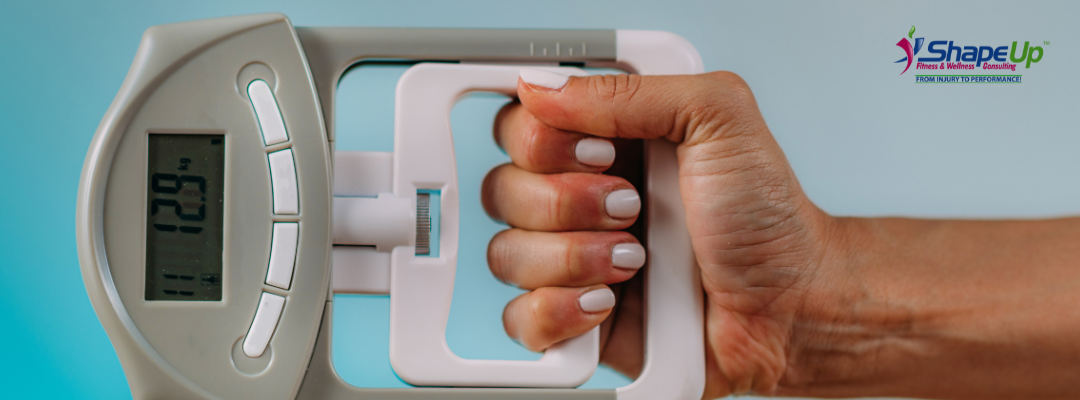
- Handgrip Strength Test: A quick and reliable way to measure overall strength.
- Push-Ups: A simple test for upper body endurance.
- Chair Stand Test: Measures lower body strength—just stand up from a chair repeatedly for 30 seconds.
- Standing Long Jump: A solid indicator of lower-body power (though maybe skip this if you have knee or hip issues).
You can find strength benchmarks online to compare yourself to others in your age group.
4. Endurance: Can You Keep Going?
You don’t need a fancy lab test to get a decent measure of your cardiovascular fitness. Try one of these:
- 6-Minute Walk Test: Walk as far as possible in six minutes.
- YMCA Step Test: Step up and down on an 8-inch step for three minutes, then measure your heart rate.
- Cooper Test: Run for 12 minutes and measure your distance—this estimates your VO₂ max.
Not everyone needs to sprint like an athlete, but having some level of endurance is essential for overall health.
5. Balance: Don’t Skip This (Especially If You’re Over 40)
Balance declines with age, but you can improve it with training. Try these progressively harder tests:
- Stand on two feet, eyes open.
- Stand on two feet, eyes closed.
- Stand in a heel-to-toe stance, eyes open.
- Stand in a heel-to-toe stance, eyes closed.
- Stand on one leg, eyes open.
- Stand on one leg, eyes closed.
If you struggle with these, balance training should be a priority—it’s a key factor in preventing falls and injuries.
Do You Have to Do These Tests? Nope!
If you’re moving, you’re already doing something great for your health. But these tests can highlight areas you might not have noticed before, helping you train smarter.
Are these assessments perfect? Of course not! But they give you a solid starting point.
What to Do Next
Once you’ve identified any weaknesses, build your training plan accordingly:
- Struggling with strength? Add resistance training.
- Poor endurance? Work in more cardio.
- Balance issues? Focus on stability drills.
And remember: sleep and nutrition are the foundations of your fitness. If those are off, your progress will be limited—so tackle them first.
For more specific guidance, don’t hesitate to consult a specialist. A little expert advice can go a long way in getting you where you want to be.
Some Test Norms:
Below you will find some tables regarding the grip strength test as well as the 6 min walk test
1. Handgrip Strength Norms
Handgrip strength is a reliable indicator of overall muscle function. The following tables present average values (in kilograms) for men and women across different age groups.
Men’s Handgrip Strength:
| Age Group (Years) | Right Hand (kg) | Left Hand (kg) |
| 20–29 | 47.0 ± 9.5 | 45.0 ± 8.8 |
| 30–39 | 47.0 ± 9.7 | 47.0 ± 9.8 |
| 40–49 | 47.0 ± 9.5 | 45.0 ± 9.3 |
| 50–59 | 45.0 ± 8.4 | 43.0 ± 8.3 |
| 60–69 | 40.0 ± 8.3 | 38.0 ± 8.0 |
| 70+ | 33.0 ± 7.8 | 32.0 ± 7.5 |
Women’s Handgrip Strength:
| Age Group (Years) | Right Hand (kg) | Left Hand (kg) |
| 20–29 | 30.0 ± 7.0 | 28.0 ± 6.1 |
| 30–39 | 31.0 ± 6.4 | 29.0 ± 6.0 |
| 40–49 | 29.0 ± 5.7 | 28.0 ± 5.7 |
| 50–59 | 28.0 ± 6.3 | 26.0 ± 5.7 |
| 60–69 | 24.0 ± 5.3 | 23.0 ± 5.0 |
| 70+ | 20.0 ± 5.8 | 19.0 ± 5.5 |
2. Six-Minute Walk Test (6MWT) Norms
The 6MWT measures the distance an individual can walk in six minutes, reflecting aerobic capacity and endurance. Below are average distances (in meters) covered by healthy adults, segmented by age and gender.
Men’s 6MWT Distances:
| Age Group (Years) | Distance (meters) |
| 60–69 | 560 ± 49 |
| 70–79 | 530 ± 48 |
| 80–89 | 446 ± 61 |
Women’s 6MWT Distances:
| Age Group (Years) | Distance (meters) |
| 60–69 | 505 ± 45 |
| 70–79 | 490 ± 48 |
| 80–89 | 382 ± 66 |
Interpreting the Data:
- Handgrip Strength: Values are presented as mean ± standard deviation. Your personal measurements can be compared to these averages to determine where you stand relative to your age and gender group.
- 6MWT Distances: Distances are also shown as mean ± standard deviation. Walking distances below the lower end of the standard deviation range may indicate below-average endurance and could warrant further assessment or training.