 Skip to content
If You Are A Runner
Advantages & Disadvantages of Choosing Pace as a Race Strategy

This article will explore the pros and cons of using pace to improve your race time.
I am a runner, and like most runners, I do like to see that I improved on my previous race times.
We all like PRs; it is really hard not to enjoy a new personal best, especially when it comes to races or runs.
We often use pacing strategies to help us accomplish those, which often works…And then it does not…So why does it fail sometimes, and other times it works great?
Now that I am getting older (I am 45 as of the time I write this article), each improvement is a little bit harder to come by and more valuable to me in some ways.
The Rub:
The problem is that pace strategies only work if the training happens on a similar terrain and elevation profile as you are racing.
If you are training on a flat course, but your race has significantly more elevation changes, you are most likely going to burn out before you finish your race if you base your race pace on the training you have done on the flat terrain. In addition, your legs are not conditioned to handle the ascend and descend of your race. You will push too hard on the uphill to maintain the pace and fatigue faster. The mechanical damage caused to the muscles by the downhill (significantly longer races) can easily finish you off.
The Potential Solution:
I shifted my “pacing strategy” over to using power. Garmin and Coros all provide power tools, but since they are GPS based, their accuracy can be off. I use a foot pod made by STRYD (at the time of this article, I have no affiliation with STRYD).
Their measurements are consistent and repeatable and measure the effort or work you put out.
When you look at a recent 5k time trial I did, you can see the average power output based on Stryd, my pace, and elevation changes.
My average power output was 331 Watts.
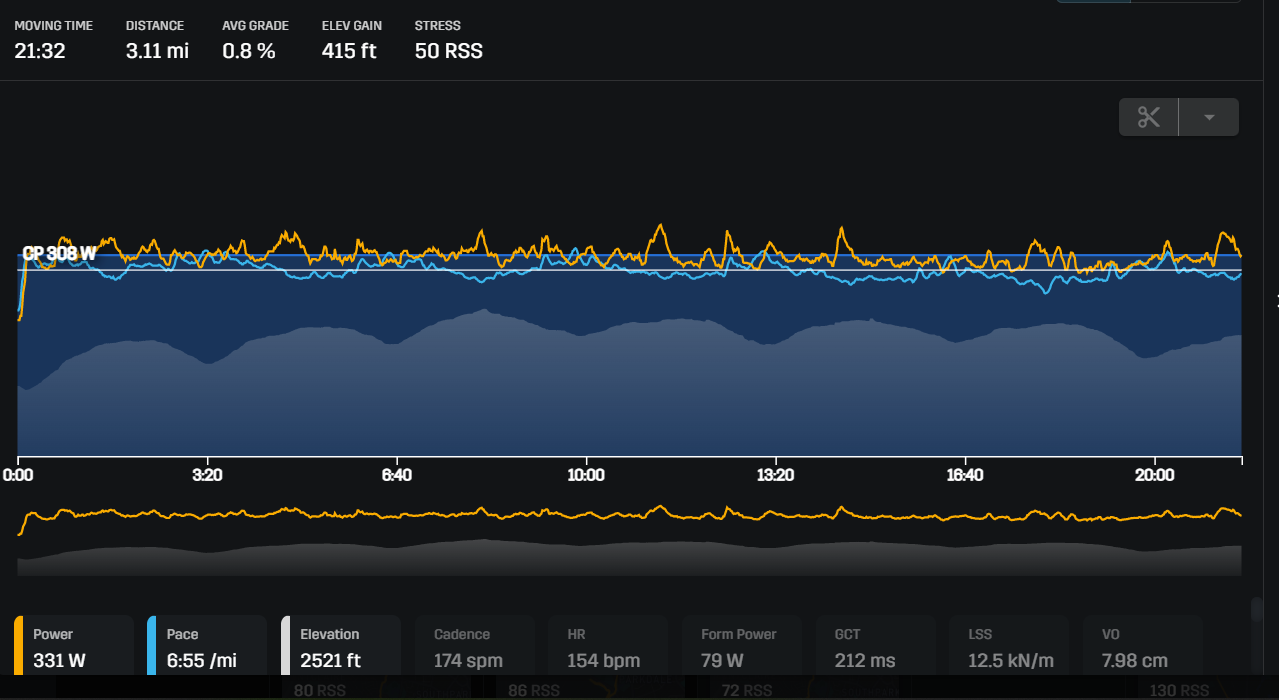
The course was at an elevation of 2,521 ft and an elevation gain of 415ft. Both values are essential.
Chances are that on a flat course with less elevation, I would be faster, while I would be slower on a more hilly course or one that is, let’s say, at 3,000 ft elevation.
Conclusion
Using pacing in a race that reflects the terrain of your training might work well. However, the problem is that you don’t always run in the same elevation profile, etc.
It might be time to replace pace with “pacing strategies” based on power the same way we replaced heart rate for intensity (different topic, different article :))
But, there is a caveat, even if you do everything right and train the way you are supposed to, there is always race day, and weather conditions; it might be the perfect day when it comes to your body, you are feeling good and strong, or you for some unforeseen reason feel like crap.
That is the beauty of racing; no matter how much preparation, you cannot take all variables into account.
For that reason, it is important to remember that enjoying what you are doing and relishing the feeling of being able to run, to begin with, is what matters most.
Your coach,
Michael Anders


